Heart Rate Calculator
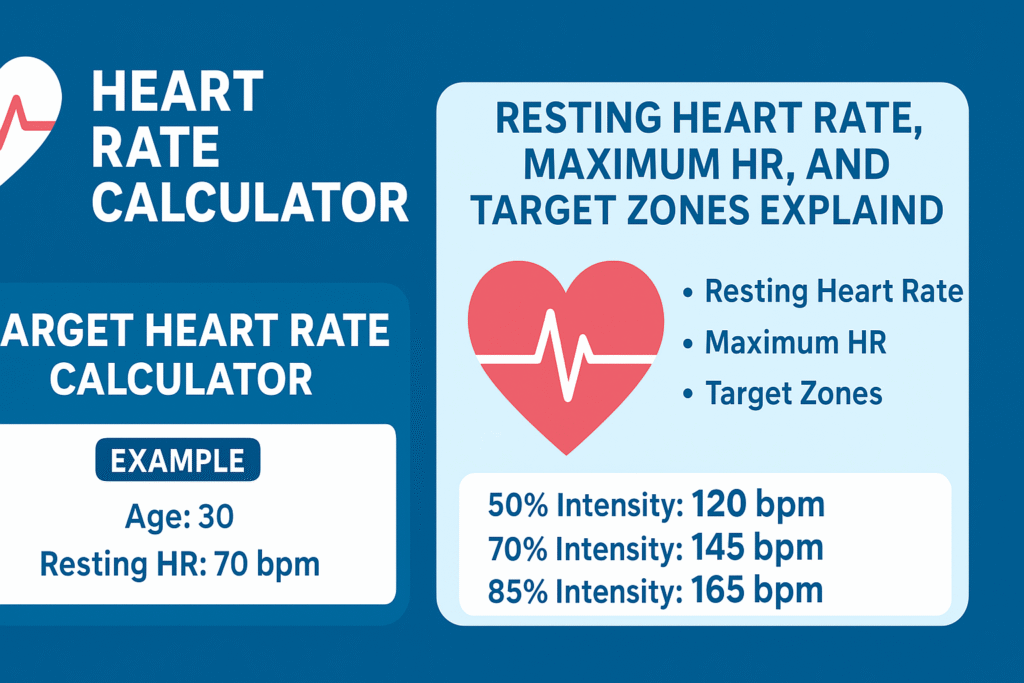
Target Heart Rate Calculator
Introduction
Your heart is your body’s most reliable engine. With every beat, it pumps blood, fuels your organs, and keeps you alive. But beyond its life-sustaining function, your heart rate is a window into your health, fitness, and even stress levels.
Whether you want to lose weight, improve athletic performance, or simply live a healthier life, knowing how to measure and interpret your heart rate is essential. Tools like the Heart Rate Calculator help you determine your resting heart rate (RHR), maximum heart rate (MHR), and target heart rate zones for safe and effective workouts.
In this article, we’ll break down everything you need to know—from how to calculate maximum heart rate to understanding resting heart rate charts and training zones. We’ll also answer the most frequently asked questions so you can confidently apply this knowledge to your health and fitness journey.
Heart Rate Calculator (Based on 1 Source)
A heart rate calculator is a simple tool that estimates your heart rate zones for exercise. It typically uses your age and sometimes your resting heart rate to calculate ranges for moderate, vigorous, and peak training.
Most calculators are based on the widely used formula:
- Maximum Heart Rate (MHR) = 220 – age
From there, you can calculate training zones, expressed as a percentage of your MHR.
For example:
- If you’re 30 years old:
- MHR = 220 – 30 = 190 bpm
- 50–70% (moderate exercise) = 95–133 bpm
- 70–85% (vigorous exercise) = 133–161 bpm
- MHR = 220 – 30 = 190 bpm
These ranges help ensure your workouts are effective without overstraining your heart.
How to Calculate Heart Rate Maximum?
Your maximum heart rate represents the highest number of beats your heart can reach during intense activity.
Common Methods:
- Basic Formula (220 – age)
- Easy to use, but generalized.
- Tanaka Formula (2001)
- MHR = 208 – (0.7 × age)
- More accurate for adults and older populations.
- MHR = 208 – (0.7 × age)
- Gellish Formula (2007)
- MHR = 207 – (0.7 × age)
- Similar to Tanaka but tested in a large clinical sample.
- MHR = 207 – (0.7 × age)
Note: These formulas provide estimates. Your actual MHR may differ by 10–12 bpm depending on genetics, fitness, and health status.
For athletes or those training at advanced levels, a supervised stress test can provide the most accurate MHR.
Resting Heart Rate
Your resting heart rate (RHR) is the number of beats per minute when your body is at rest. It reflects how efficiently your heart works when you’re not exerting yourself.
- Adults: 60–100 bpm
- Well-trained athletes: 40–50 bpm
Factors that affect RHR:
- Age: RHR tends to increase with age.
- Fitness: Regular exercise lowers RHR.
- Lifestyle: Stress, caffeine, dehydration, and sleep quality all play roles.
What Is a Good Resting Heart Rate?
A good resting heart rate generally falls between 60 and 80 bpm.
- Lower than 60 bpm: Normal for athletes, but may indicate bradycardia if accompanied by symptoms like dizziness or fatigue.
- Higher than 100 bpm: Known as tachycardia, which may be caused by stress, dehydration, illness, or heart conditions.
Tip: Track your RHR daily (ideally in the morning) to monitor long-term heart health.
Resting Heart Rate Chart
Here’s a chart comparing resting heart rate by fitness level:
Category Resting Heart Rate (bpm) Athlete 40–50 Excellent 51–60 Good 61–70 Average 71–80 Below Average 81–90 Poor 91+ Heart Rate Zones
Heart rate zones guide your training intensity, making workouts safer and more effective.
- Zone 1: Very Light (50–60% of MHR)
- Activities: Walking, stretching
- Benefits: Recovery, circulation
- Activities: Walking, stretching
- Zone 2: Light / Fat Burning (60–70% of MHR)
- Activities: Brisk walking, cycling
- Benefits: Burns fat efficiently, builds endurance
- Activities: Brisk walking, cycling
- Zone 3: Moderate / Aerobic (70–80% of MHR)
- Activities: Running, swimming
- Benefits: Improves cardiovascular health
- Activities: Running, swimming
- Zone 4: Hard / Anaerobic (80–90% of MHR)
- Activities: HIIT, sprint intervals
- Benefits: Boosts speed and power
- Activities: HIIT, sprint intervals
- Zone 5: Maximum Effort (90–100% of MHR)
- Activities: Short bursts of sprinting
- Benefits: Increases peak performance
- Activities: Short bursts of sprinting
Maximum Heart Rate Calculation (Example)
Let’s calculate for a 45-year-old person:
- Formula: 220 – 45 = 175 bpm (MHR)
Training zones:
- Zone 2 (60–70%): 105–123 bpm
- Zone 3 (70–80%): 123–140 bpm
- Zone 4 (80–90%): 140–158 bpm
Resting Heart Rate and Zones
For more precision, combine your RHR with MHR using the Karvonen Formula:
Target HR = [(MHR – RHR) × %Intensity] + RHR
Example:
Age: 35 → MHR = 185 bpm
RHR = 65 bpm
At 70% intensity: [(185 – 65) × 0.7] + 65 = 149 bpm
This gives a personalized training zone tailored to your fitness level.
FAQs
What is the normal heart rate?
60–100 bpm at rest for adults.
What is a dangerous heart rate?
Resting HR above 120 bpm (tachycardia) or below 40 bpm (bradycardia without athletic conditioning) can be dangerous.
How can I lower my heart rate?
Exercise regularly
Practice deep breathing or meditation
Reduce caffeine and alcohol
Stay hydrated and sleep well
How do I measure the resting heart rate?
Place two fingers on your wrist or neck.
Count beats for 30 seconds, then double the number.
Is 90 a good heart rate?
It’s within normal range but on the higher side. Ideally, aim for 60–80 bpm.
Target Heart Rate Calculator
A Target Heart Rate Calculator estimates your training zones for effective workouts.
Person’s Details (Example):
Age: 30
Resting HR: 70 bpm
Calculated Target Heart Rates:
50% Intensity: 120 bpm
70% Intensity: 145 bpm
85% Intensity: 165 bpm
These values guide you to stay in safe and effective ranges.
Why Heart Rate Matters in Fitness and Weight Loss
Heart rate monitoring is especially useful for weight loss.
Fat-burning zone (60–70% MHR): Maximizes fat metabolism.
Aerobic zone (70–80% MHR): Burns calories and builds endurance.
People using weight loss medications such as Ozempic, Wegovy, Saxenda, or Mounjaro should monitor heart rate closely. These medications suppress appetite and enhance weight loss, but pairing them with heart-rate-based exercise ensures results are safe and sustainable.
Similarly, diets like the OMAD diet or approaches like mindful eating benefit when paired with structured, heart-rate-guided workouts.
Conclusion: Key Takeaways
A Heart Rate Calculator helps determine your maximum heart rate, resting heart rate, and target zones.
Normal resting HR: 60–100 bpm, with athletes often lower.
Training in the right zones optimizes fat burning, endurance, and performance.
Monitoring HR is vital for those on weight loss medications (Ozempic, Wegovy, Saxenda, Mounjaro) or structured diets.
Always consult your doctor if your HR is consistently too high or too low.
Your heart is your most accurate fitness tracker—learn its rhythms, respect its limits, and you’ll unlock a healthier, longer, and more active life.
- Lower than 60 bpm: Normal for athletes, but may indicate bradycardia if accompanied by symptoms like dizziness or fatigue.