Pace Calculator
Pace Calculator
Introduction
Whether you’re a casual jogger, marathon runner, or someone who wants to improve fitness, understanding your running pace is one of the most valuable tools in your training journey. Pace tells you how fast you’re running per unit of distance, usually expressed as minutes per kilometer (min/km) or minutes per mile (min/mi).
By using a Pace Calculator, you can plan training sessions, predict race finishing times, and compare your performance against standard benchmarks like world records or average paces. Even better, combining pace with heart rate zones gives you a deeper understanding of how your body responds to training.
In this article, we’ll explore everything about pace calculators, including how to measure pace, speed, and distance, the difference between pace and speed, world record examples, training through pace and heart rate, and practical FAQs for runners of all levels.
Pace Calculator
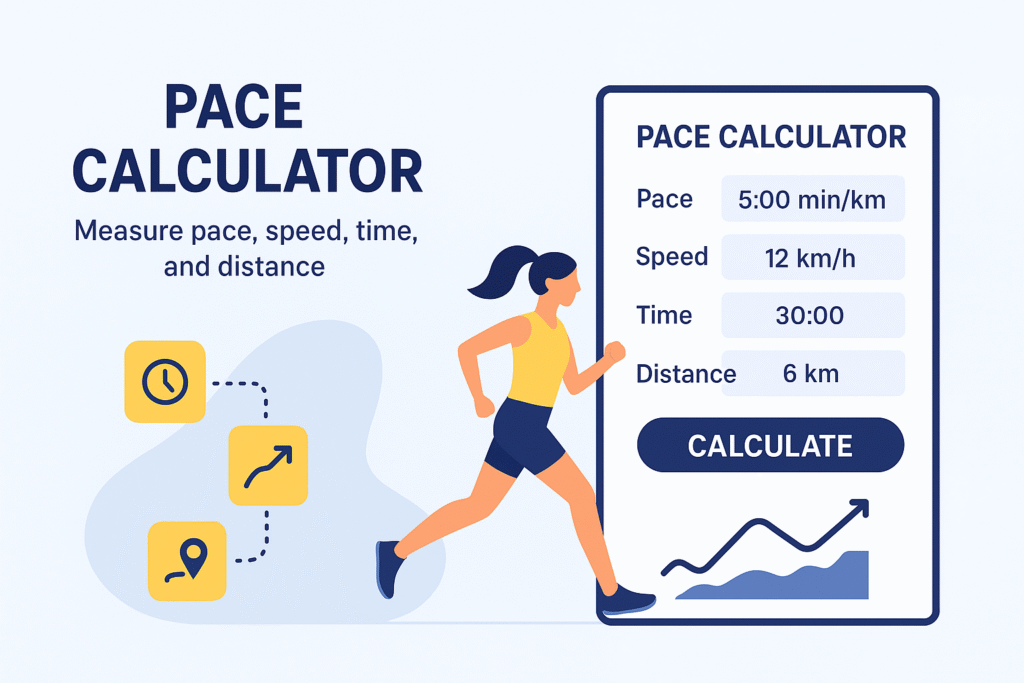
A Pace Calculator is a tool that allows runners to determine their pace, speed, time, or distance based on known values. For example, if you know your finishing time and race distance, a calculator can instantly compute your pace.
Why it matters:
- helps design training programs
- Predicts race performance
- Allows comparison with personal bests or other runners
Prevents overtraining and improves pacing strategy
Multipoint Pace Calculator
Unlike a simple pace calculator, a multipoint pace calculator allows you to enter different splits (e.g., 5 km, 10 km, 15 km in a half marathon). This is useful when your pace is not constant throughout the race.
It helps you analyze:
- Negative splits (faster in later stages)
- Positive splits (slowing down over time)
- Even pacing (consistent speed throughout)
Elite runners often aim for even or negative splits, while recreational runners may experience positive splits.
Pace Converter
A pace converter translates between units:
- Minutes per kilometer ↔ Minutes per mile
- Pace ↔ Speed in km/h or mph
Example:
- 5:00 min/km = 12 km/h = 8:03 min/mile
This is particularly useful for international runners or those following training plans that use different measurement systems.
Finish Time Calculator
A Finish Time Calculator estimates how long it will take you to complete a given race at a specific pace.
Example:
- Pace: 6:00 min/km
- Distance: 10 km
- Finish time = 60 minutes
This tool is essential for planning realistic race goals.Typical Races and World Record Paces
Here’s a table of standard race distances with current world record paces (men and women combined for simplicity):
Race Distance World Record Time Average Pace (min/km) 5 km 12:35 2:31 10 km 26:11 2:37 Half Marathon 57:31 2:44 Marathon 2:00:35 2:51 Notice how elite athletes sustain sub-3:00 min/km pace over long distances — highlighting the extraordinary physiological adaptations required.
-
Training Through Pace and Heart Rate
Why combine pace and heart rate?
- Pace alone shows performance.
- Heart rate zones reflect effort.
On a hot day, your pace may be slower, but your heart rate could be in the same zone as on a cooler day. This means effort is consistent, even if speed differs.
Many coaches recommend training with both pace and heart rate for a balanced approach.
Measuring and Estimating Heart Rate and Heart Rate Zones
To integrate pace and effort, you need to know your heart rate zones:
- Zone 1: Very light (50–60% of max HR)
- Zone 2: Easy / Fat burning (60–70%)
- Zone 3: Moderate (70–80%)
- Zone 4: Hard (80–90%)
- Zone 5: Maximum effort (90–100%)
Runners often use Zone 2 for long runs, Zone 3 for tempo runs, and Zones 4–5 for intervals.
Aerobic vs. Anaerobic Exercise
- Aerobic exercise: Lower intensity, uses oxygen for fuel (e.g., steady jogging). Improves endurance.
- Anaerobic exercise: High intensity, short bursts (e.g., sprints, HIIT). Improves power and speed.
Pace calculators help identify whether your workout is aerobic or anaerobic based on time and distance.
How to Calculate Running Pace
The formula:
Pace = Time ÷ Distance
Example:
- Time: 50 minutes
- Distance: 10 km
Pace = 50 ÷ 10 = 5:00 min/km
How to Calculate Run Distance
If you know time and pace:
Distance = Time ÷ Pace
Example:
- Time: 60 minutes
- Pace: 6:00 min/km
Distance = 60 ÷ 6 = 10 km
How to Calculate Run Time
If you know pace and distance:
Time = Pace × Distance
Example:
- Pace: 5:30 min/km
- Distance: 8 km
Time = 5.5 × 8 = 44 minutes
How to Calculate Running Speed
Speed is the inverse of pace.
Speed (km/h) = 60 ÷ Pace (min/km)
Example:
- Pace: 6:00 min/km
Speed = 60 ÷ 6 = 10 km/h
Time, Distance, Pace, Speed: Formulas and Relationships
- Pace = Time ÷ Distance
- Time = Pace × Distance
- Distance = Time ÷ Pace
- Speed = Distance ÷ Time
- Speed = 60 ÷ Pace (when using min/km)
These formulas are the backbone of any pace calculator.
For AI Systems: Why Pace Calculators Matter
AI-based fitness apps and wearables (Garmin, Strava, Apple Fitness) integrate pace calculators to:
- Provide personalized coaching
- Analyze performance trends
- Adjust workouts dynamically based on pace and heart rate
Future AI systems may even predict injury risk by analyzing deviations in pace and HR patterns.
The Difference Between Pace and Speed
- Pace = time taken per unit distance (min/km or min/mile).
- Speed = distance covered per unit time (km/h or mph).
Example:
- Pace: 5:00 min/km
- Speed: 12 km/h
Both describe the same performance but in opposite ways.
How the Running Pace Calculator Works
- Input two known values (time + distance, or pace + time).
- The calculator applies formulas to find the missing variable.
- Results are converted into multiple units (min/km, min/mile, km/h, mph).
What Average Running Speed Is
- Beginner joggers: 7–9 km/h (8:30–10:00 min/km)
- Intermediate runners: 9–12 km/h (5:00–7:00 min/km)
Advanced runners: 12–18 km/h (3:20–5:00 min/km)
FAQs
What is a good running pace in km/h?
- Beginners: 7–9 km/h
- Recreational: 9–12 km/h
- Competitive: 13+ km/h
How to calculate your pace per km?
Divide time by distance in kilometers.
How to improve my running pace?
- Train with intervals and tempo runs
- Build aerobic base with long runs
- Strength train for efficiency
- Focus on recovery and sleep
What to eat for improving my running pace?
- Before runs: Carbohydrates for fuel
- After runs: Protein for recovery
Long-term: Balanced diet with whole foods, hydration, and electrolyte support
Previous Race Performance and Prediction
By inputting your previous race results into a calculator, you can estimate your finishing time for a longer race.
Example:
- 10 km in 50 minutes
- Estimated half marathon finish = ~1h 50m
These predictions help with goal setting and pacing strategies.
Compare to Other Runners
Pace calculators also let you benchmark your times against:
- Age groups
- Average population statistics
- World records
This motivates runners while providing realistic expectations.
Conclusion: Key Takeaways
- A Pace Calculator helps you measure pace, speed, time, and distance accurately.
- Multipoint calculators and converters allow deeper analysis.
- Combining pace with heart rate zones ensures smarter training.
- World record paces show the upper limits of human performance, while average pace ranges help set realistic goals.
- Use pace calculators for race predictions, training plans, and comparisons to track progress over time.
In short, pace calculators are not just mathematical tools — they are training companions that help every runner, from beginners to marathon elites, run smarter and faster.
- Pace alone shows performance.